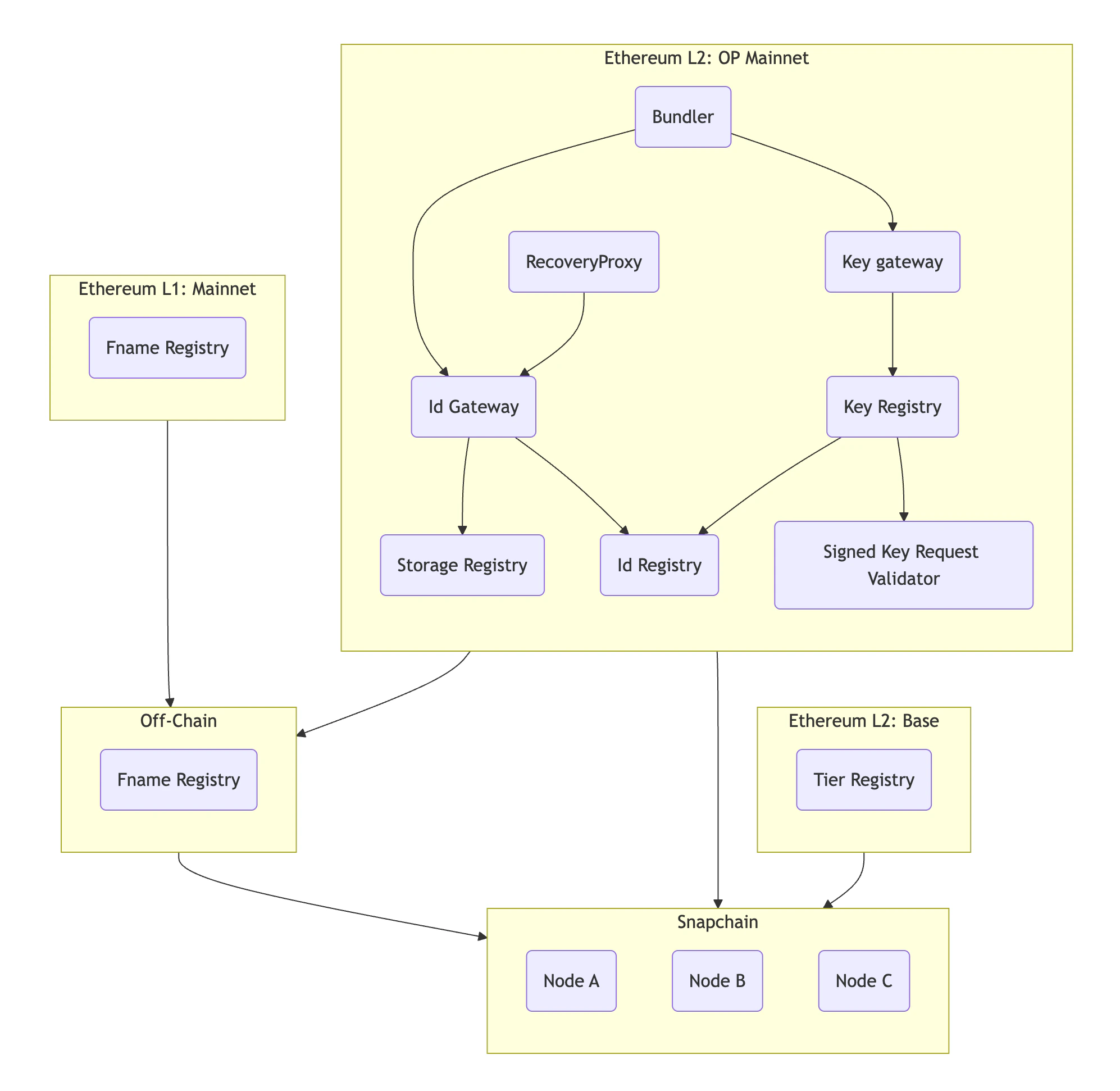
The core Farcaster contracts are deployed on Optimism, an Ethereum layer 2 network. There are three core contracts:
Id Registry, Key Registry, and Storage Registry. Write access to the ID and Key registry is gated through the Gateway
contracts. There is also a Bundler helper contract to make it easy to register an fid, add a key and rent storage in one
transaction.The Tier Registry contract supporting Farcaster Pro subscriptions is deployed on Base, an Ethereum layer 2 network.
The Id Registry contract is used to keep track of Farcaster IDs. It maps an fid to an owning Ethereum
address. The owner can also designate a “recovery address” which can be used to recover the fid if the owner loses
access to the registering address. Registering an fid for the first time must be done through
the ID Gateway.
The Key Registry associates a Farcaster id to zero or more ed25519 public keys. Only messages signed by a key registered
here are considered valid by the hubs. Registered keys can be revoked by the owner of the fid, but revoked keys can not
be added to that fid again. The same key may be registered to multiple fids. Adding a key must be done through the
Key Gateway.
The Storage Registry allows an fid to rent one or more “units” of storage on the farcaster network. The current cost of
storage is 7$ USD per unit, for one year. This fee must be paid in ETH. The storage registry uses an ETH price oracle to
determine the current cost in ETH and exposes functions to query this price. Overpayments are refunded to the caller.
The ID Gateway handles additional logic required for first time registration of an fid. To prevent spam, the
gateway also requires renting 1 unit of storage.
The Tier Registry collects subscription payments for Farcaster Pro, paid in USDC. Unlike other core protocol contracts,
it is deployed on Base mainnet.